
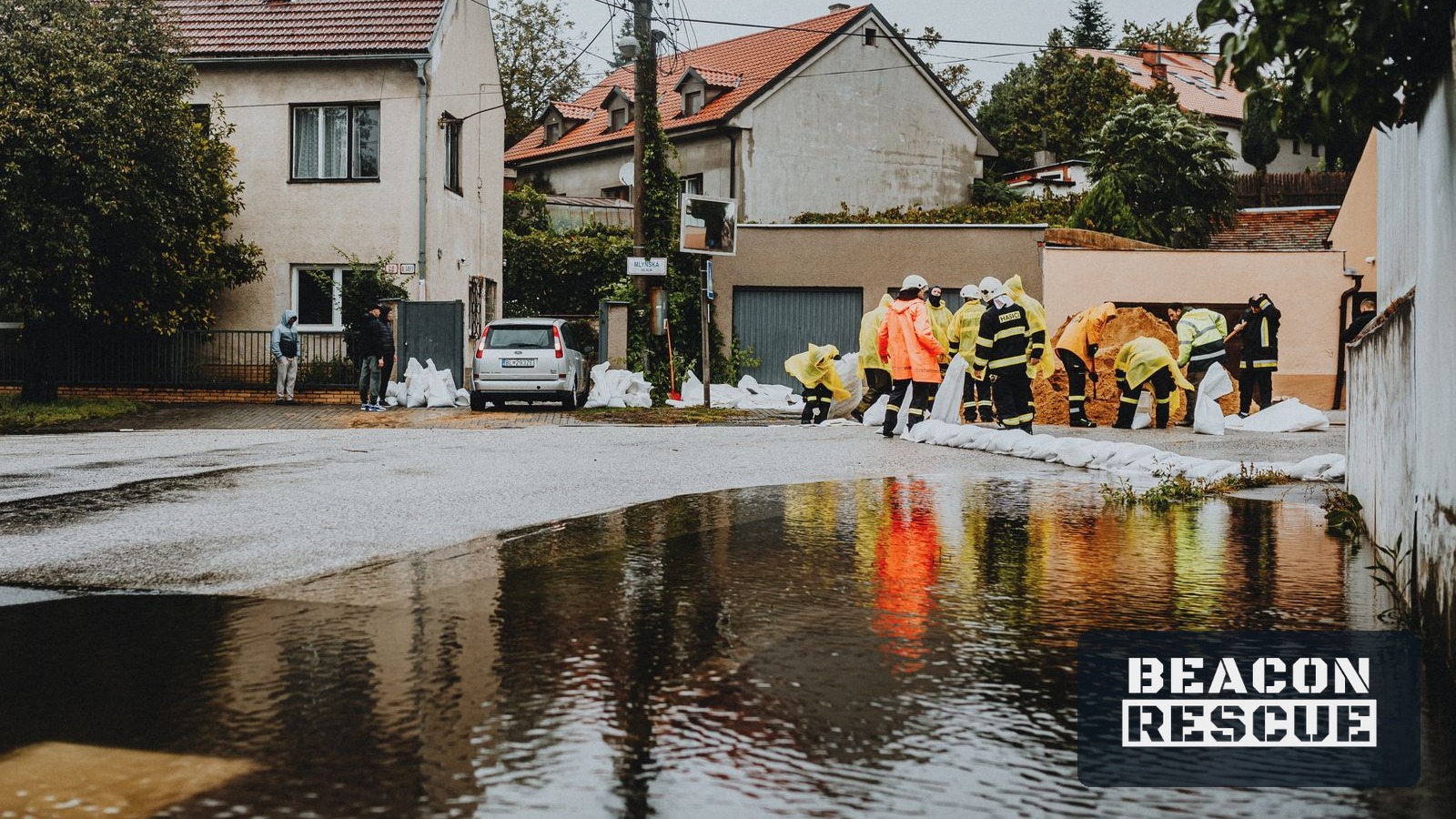
What a Deployment Really Looks Like: Hour by Hour With a Beacon Rescue Team
People picture a deployment as the photograph: a boat in moving water, a team in the current, someone reaching a person who needs reaching.
That moment exists. It also represents a very small fraction of the hours. Most of a deployment is logistics, coordination, and repetitive, unglamorous work done by people who are tired and wet — and it's precisely that unglamorous part that determines whether the photograph ever happens.
Here is what the clock actually looks like.
Before hour zero: the part that happens in advance
A team that starts preparing when the call comes is already late.
Gear is staged and inventoried before storm season, not after a forecast. Certifications are current. Trailers are loaded. The roster is known — who can leave on short notice, who has a work situation that makes a three-day deployment possible and who doesn't. Relationships with county emergency management, sheriff's offices, and partner nonprofits are built in ordinary weeks, over coffee and at training days, when nobody needs anything from anybody.
That last item is the one outsiders miss most. In the first 24 hours of a disaster, the question is never "who wants to help." It's "who are you, and why should I put you inside my incident." Agencies that already know you get assigned. Agencies that show up cold get parked.
Hours 0–6: activation and the drive
A request comes through a partner agency or an emergency management contact. It is specific: what capability is needed, where to report, who to check in with.
The first decision is honest self-assessment — can we field the capability they're actually asking for, with people who are current and rested enough to be useful? Saying no to a mission you can't staff properly is a real part of this work. An under-resourced team becomes another problem for the incident to manage.
Once committed, the team assembles, loads, and drives. The drive itself is a working period: assignments briefed, maps reviewed, communications plan confirmed, everyone clear on who they report to on arrival. Nobody arrives asking what the plan is.
Hours 6–12: check-in and the reality adjustment
The team checks in through the incident command structure. This is not a formality. It is how a deployment stays coordinated instead of becoming a collection of well-meaning people working at cross purposes.
And this is where the plan meets the ground. The assignment written down in hour two is frequently not the assignment given in hour eight, because conditions moved. A road that was open is closed. A neighborhood that was a priority has been cleared by someone else. A different area nobody had eyes on has become urgent.
Flexibility here is not improvisation. It's the ability to take a new assignment inside a known structure, because the structure is what makes the change safe.
Hours 12–36: the work
Whatever the assignment turns out to be, the rhythm is similar: operate, rotate, rest, repeat.
Water work is physically punishing and cognitively demanding at the same time. Moving water contains almost all of the hazard in a flood, and it does not forgive fatigue. Teams work in rotations with deliberate rest — not because anyone wants to stop, but because the injury rate for exhausted responders is the thing that ends a deployment early.
A great deal of the work is not rescue at all. It's welfare checks on addresses nobody has heard from. It's access — clearing a route so a heavier asset can get through. It's the search that finds nobody, which is the outcome everyone wants and nobody photographs. It's carrying supplies. It's the same street, twice, because the first pass was in the dark.
Documentation runs through all of it. Every address checked, every person contacted, every area cleared gets recorded and passed up. That record is how the incident avoids searching the same house four times while another goes unvisited.
Hours 36–72: the phase that gets no coverage
News crews leave when the water goes down. The need doesn't.
The days after are supply distribution, muck-outs, coordination with local churches and volunteer organizations who will still be there in six months, and the beginning of the long handoff to recovery. This is also where our second mission becomes relevant: displacement, chaos, and desperate circumstances create exactly the conditions that traffickers exploit. Teams that understand what to watch for in shelters and distribution points are a genuine protective presence, and that awareness comes from training, not instinct.
Demobilization: the part nobody plans for
Coming home has its own requirements. Gear is cleaned, inspected, repaired and re-staged — a deployment isn't over until the team could leave again tomorrow. There's an after-action review: what worked, what didn't, what we'd do differently.
And there's the human side. People go back to jobs and families carrying what they saw. Checking on each other in the weeks after is part of the job, not an add-on to it. Teams that skip this lose people — not to a single event, but to accumulation.
What this means for the training mission
Read that timeline again and notice where the failures would occur. Almost none of them are in the rescue itself. They're in preparation, in coordination, in fatigue management, in documentation, in knowing how to plug into a command structure.
That is exactly what our free first-responder training addresses, and it's why our 2026 campaign focuses on training 100 Tennessee volunteer firefighters at no cost to them or their departments. The idea came directly out of the Hurricane Helene response and our work with the Erwin Fire Department. Rural departments field the same water, the same terrain, and the same clock as anyone else — usually with a fraction of the budget and volunteers who pay for their own gear.
Swift water, ropes, and medical training given free to a volunteer department doesn't just help that department. It means the next flood in that county is met in hour two by people who are already there, already trained, and already known to their county EMA.
How to help
Deployments run on equipment that's been maintained, training that's been paid for, and fuel in the trailer. If you want the hour-by-hour above to keep happening, the most direct support is funding the preparation it depends on.
Make a donation, or if you're with a volunteer department, an EMA, or a partner agency and want to talk about training, get in touch with us.